
Engineering the Future one product at a time

Dual-Drive Tri-Ring teethed cycloidal Actuator
This project explores the adaptation of heavy industrial speed reducers for modern robotics, aiming to achieve high torque density and continuous-use reliability in a compact, 3D-printable package. Inspired by high-load tri-ring industrial reducers, I designed an eccentrically driven cycloidal gear system utilizing three internal-toothed plates phased at 120°. The architecture leverages the small tooth difference principle to achieve high load capacity with minimal backlash, translating heavy-industry robustness into a dual-motor robotic actuator. The kinematics of the eccentric orbital motion were validated using SolidWorks Motion simulations and a fully functional 3D-printed prototype, resulting in a simplified mechanical architecture suitable for high-torque robotic applications.
Automated Deployable Cup Holder System
Developed to improve desk ergonomics and prevent equipment damage due to spills, this mechatronic system provides on-demand container support through a compact retractable assembly. An ESP32 controls a motor-driven lead screw mechanism that converts rotary torque into precise linear extension for smooth, reliable deployment. A responsive control loop uses an acoustic sensor to detect a knock and trigger deployment, while an integrated load cell monitors cup occupancy to command autonomous retraction. The project demonstrates the integration of sensing, control, and mechanical actuation into a seamless, space-efficient user interface.
Electrolyte temperature control system
Developed during my time at Cuberg/NorthVolt, this project addresses a critical process constraint in battery pouch cell manual assembly: maintaining electrolyte temperature stability during open-container handling. I designed a custom thermal receptacle to provide constant-temperature housing for the electrolyte while containers were actively used by operators, preventing viscosity changes and maintaining consistent process conditions. The system integrates a precision heating element, thermocouple feedback, and a closed-loop temperature controller with on/off regulation to maintain the target temperature with fast response and stable operation. An aluminum sleeve provides efficient heat transfer to the container, while an insulated outer layer minimizes heat loss and improves operator safety.
Thermal Energy Storage test module
Developed in the Renewable Energy Systems Lab at San Francisco State University, this project focused on the design of a lab-scale test module for a cascading thermal energy storage system. I designed the module to support broader research in system optimization and machine-learning-based dynamic control. The system was modeled in SOLIDWORKS and analyzed in ANSYS to evaluate flow distribution, pressure drop, and heat transfer. The design uses a spiral heat exchanger architecture selected for its low pressure drop and ease of fabrication, with aluminum channel walls and embedded copper PCM tubes to maximize thermal conductivity and thermal storage capacity.
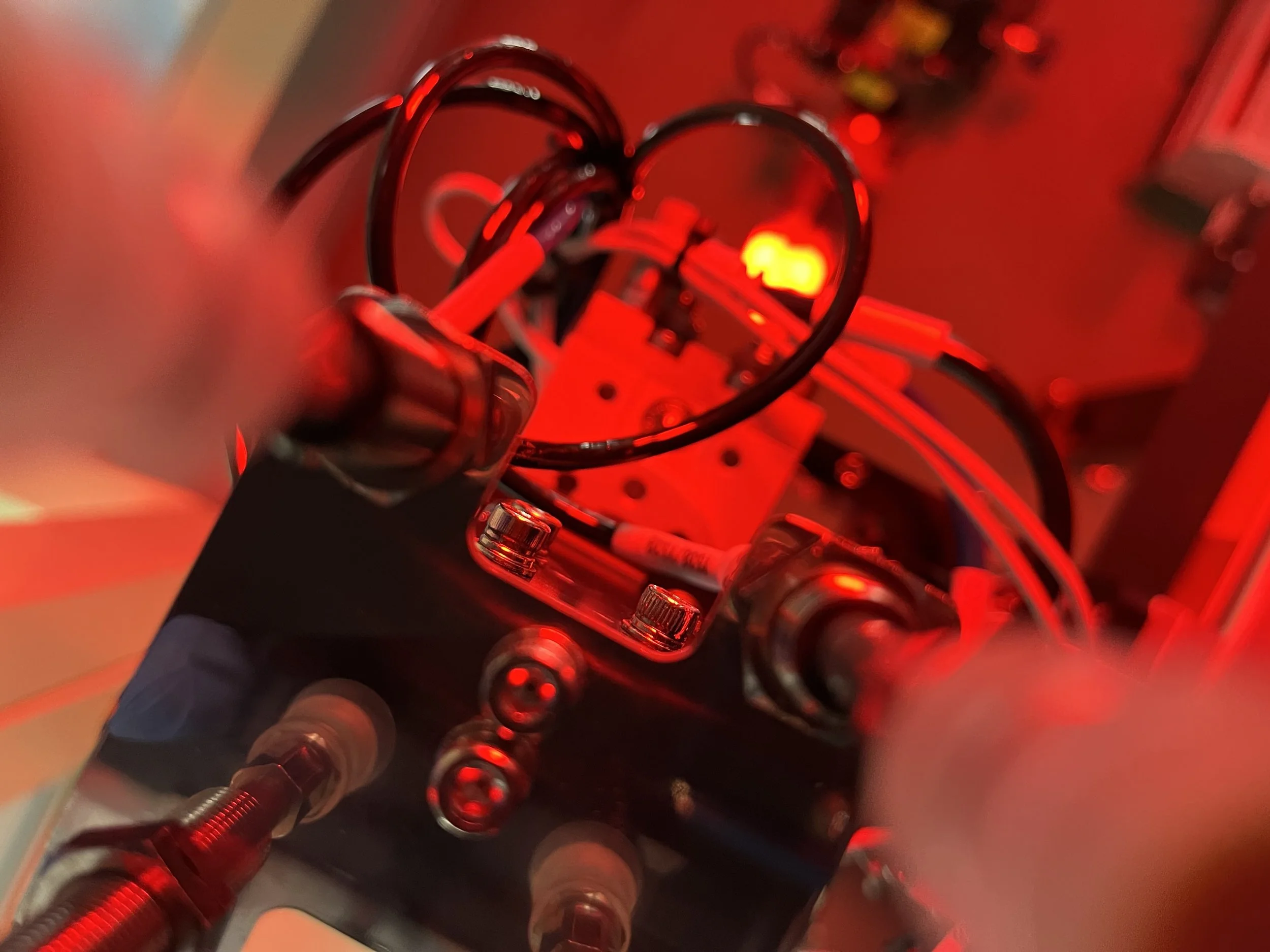
Battery Manufacturing and equipment engineering
During my time at Cuberg/Northvolt, I supported the production of advanced battery cells by improving the reliability of a semi-automatic jelly roll stacking system.
My work focused on equipment maintenance, troubleshooting, and Root Cause Analysis (RCA) of critical mechanical failures to reduce downtime. I implemented targeted design improvements to precision machine components, contributing to increased process stability, equipment reliability, and assembly yield.
This role involved working directly with automated systems in a high-precision manufacturing environment, developing hands-on experience in diagnosing complex failures and maintaining performance under strict quality standards.